The audience at the Brindle Historical Society meeting on Monday 16th September were aroused after their summer break by a startlingly loud hand-bell rung by the Town Crier of Great Harwood, Rawden Kerr who visited us to explain the long history of town criers. Once his bell was replaced into its purpose-made holster slung round his waist, which ensures that his hands are free to hold the scroll, Rawden told us about his uniform which was predominantly red and black. There is no set style of dress for a town crier with each community choosing whatever they like.
The concept of a town crier goes back millennia to Greek times. A man called Stentor, whose cry was said to be as loud at 50 men, was a herald, and today the word stentorian is still used to depict anyone with a particularly loud voice. For most people, perhaps the most famous heralds were the angels in the bible bringing news of Jesus’ birth to the shepherds and although they weren’t given that title, these angels could be considered among the first town criers. Roman messengers were also cited as early-day examples, but sadly if their messages were of bad news, the chances of being executed were high – hence the plea of “don’t shoot the messenger”.
Three things are required of a town crier: to be honest and true, to be loyal to the monarch and to keep your head. In fact, they were deemed to be so very important and trustworthy that a law was passed to make it a treasonable offence to molest a town crier – Rawden was keen to inform us that this law has never been repealed!
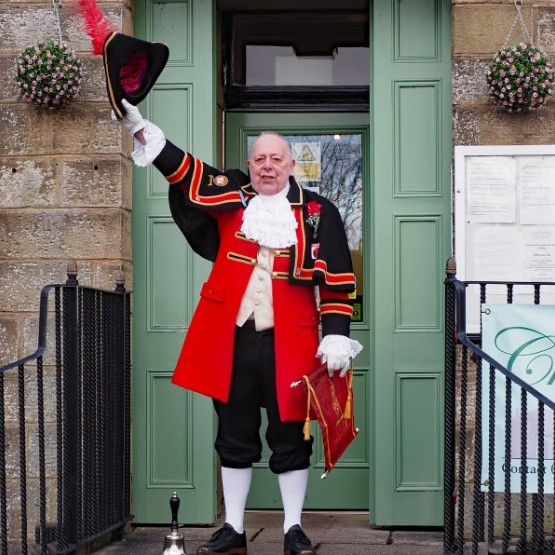
In all these examples, the messengers were used because most people were unable to read or write, and the main skill required of a crier, apart from a loud, clear voice, was a good memory. The criers would move about the town to announce important news to everyone but after the invention of the printing press, they were less reliant on memory since the proclamation would be nailed to posts at strategic positions around the town for everyone who could read to do so. These posts became the origin of the modern Post Office where news was disseminated and also why so many newspapers had the word ‘post’ in their title.
Not all towns have a town crier; there are none in Chorley, Blackburn or Burnley for instance. That Great Harwood still does have one is due to a Royal Charter given in 1388 allowing the town to hold a week-long fair from 21st August each year. This can only be upheld, however, if the town crier gives a cry on that date. Rawden (or his apprentice) are assiduous in maintaining this tradition, even if the fair doesn’t always happen.
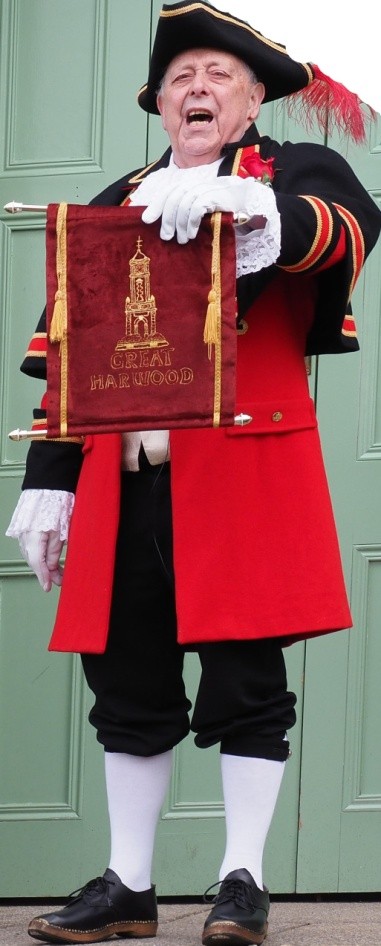
In an answer to a question after the talk on inclusivity, Rawden will be looking at ways of translating his cry into other languages including possibly sign language for those hard of hearing. As you can tell, the position of Town Crier is still very much alive today.
Leave a Reply