The large audience attending the Brindle Historical Society meeting on Monday 17th June were treated to a remarkable talk and video presentation about the Battle of Bamber Bridge. This unusual battle between American soldiers stationed here took place in June 1943. Professor Alan Rice (Professor in English and American Studies at UCLAN and co-director of the Institute for Black Atlantic Research) was very well qualified to explain about how this battle occurred between troops both apparently fighting on the same side.
During World War II, of the 1.2 million US troops who were stationed in the UK, approximately 10% of them (120 thousand) were African Americans who were segregated from the white troops and were not allowed to fight in combat divisions. Instead, they were stationed in separate barracks and only employed as support staff (cleaning, cooking, driving etc.) which instinctively felt wrong to British people. For their part, the black troops were amazed that no-one expected them to step into the gutter if they met a white person on the pavement and so were very polite and humble and delighted to have been welcomed by the people of Bamber Bridge. The UK government actually enabled this racism by passing a law (The Visiting Forces Act) which, amongst other things, stated that if US troops broke any laws, they would be tried by the US Military Court, not by English law. The remarkable thing to note is that the Allies (including British and American) were fighting fascism which at its heart is about racial supremacy and yet racism was being clearly displayed.
The black troops were warmly welcomed into the community as friends and began attending local church services and going for drinks in local pubs. The US Military Police (MP), who were all white, became upset by this and felt that the blacks were ‘getting above their station’ by integrating, and in some cases fraternising, with the locals. The MPs believed that blacks had to follow the standards that had been set by the US army, which, of course, were different to those followed in the UK, where there was no segregation.
The black troops had complained for months about this racism to no avail and so at 10pm on Thursday 24th June 1943, the tension in the town reached a critical point when two MPs entered the Hob Inn and found a black man committing some minor infringement and tried to arrest him. Others stood up for their colleague and the MPs, being outnumbered, left and sought reinforcements. When they returned with two others, the black soldiers were walking back to their barracks and on the way were chatting to three ATS women.
Upset by this fraternising, the armed MPs once more tried to arrest the unarmed black men but were once more forced back. At this point the black troops had decided to stand up for their rights and had raided the armoury and took over their camp. When more MPs returned later, one of their jeeps had a machine gun mounted on it which set off a long battle between the troops. In the five hour on the streets of Bamber Bridge over 400 shots were fired and one black soldier was killed. This death was never investigated afterwards, but 37 of the black participants were court-martialled and many were charged.
To date, none of those charged has been pardoned, yet this incident (along with similar ones around the country) contributed to the rise of the civil rights movement led by Martin Luther King.
And so a local story has national and global implications. A book telling this story is to be published soon and will be available in the Hob Inn pub in July and will include a DVD of interviews with witnesses of the battle.
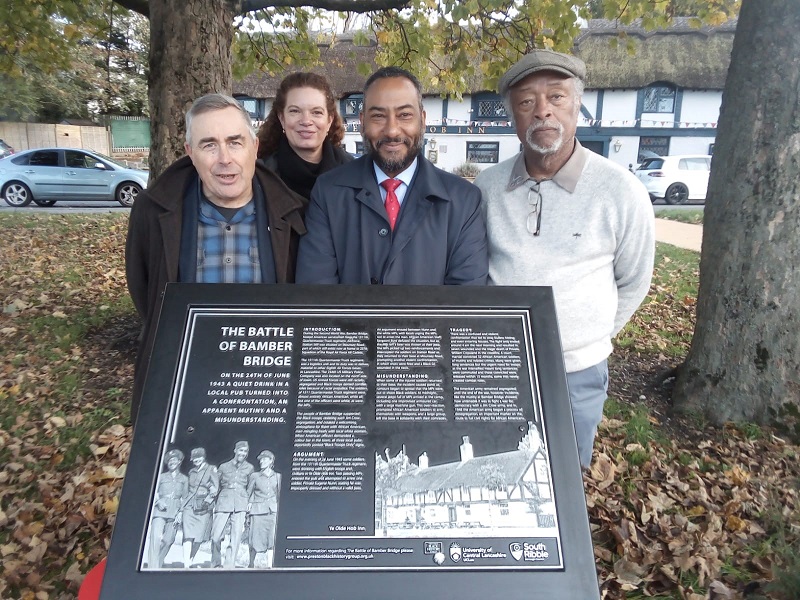
(L-R) Professor Alan Rice, Jemma Rodgers, Producer of The Return of the Railway Children, Aaron Snipe, Senior Foreign Service Officer, Embassy Spokesperson US Embassy, and Clinton Smith, Chair, Preston Black History Group. Photo credit Tony Maiden from the Black History Group.
Leave a Reply