On Monday 15th January 2024 the Brindle Historical Society held its first meeting of the year when we invited speaker Russell Parry to tell us about the Appley Bridge Meteorite. Before this evening, none of the audience knew anything about this event which happened on Tuesday October 13th 1914 soon after the start of the First World War. When Russell, who had an interest in local history and astronomy, moved to the district in the 1990s, he saw a small article in a local publication about a meteorite landing. This sparked an interest in this fascinating and rare phenomenon and so he began researching it. In 2013 he had sufficient information to write a book about his findings, and he now travels extensively giving talks on this subject to interested parties, including cruise ships and astronomical societies.
In 1914, the residents of Appley Bridge near Wigan experienced an extremely bright fireball with a long trail travelling quickly across the night sky, accompanied by loud crashes and bangs like thunder. Many locals feared a German Zeppelin dropping bombs on the area, but it was only after two local men found a large object weighing some 33lbs (15kg) embedded in the ground about 2 feet (60cm) deep near a farm did the truth emerge. The police were informed and soon the object was confiscated and taken to County Police headquarters at Preston for examination.
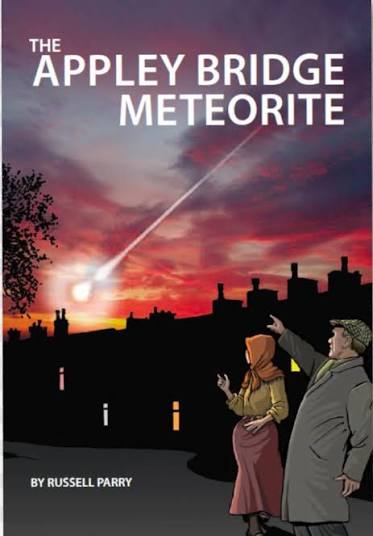
The object was identified as a meteorite and a part of it which had broken off on impact was later sent to a grocer’s shop in Appley Bridge where it was displayed for the residents to see. The bulk of the meteorite eventually found its way to what is now the Natural History Museum in London where it still resides. It has been described as ‘a most excellent example’ and was then (and still remains) the largest meteorite to fall in Great Britain in 230 years.
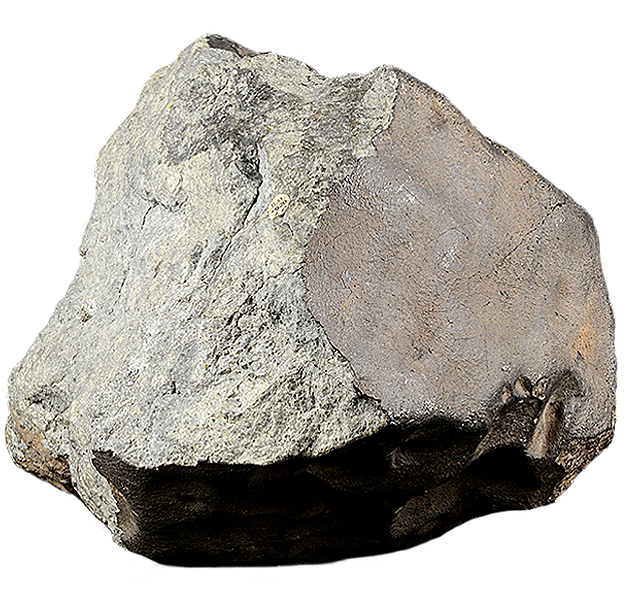
So what is a meteorite? Well, let’s start by describing meteoroids which are solid objects moving through interplanetary space. When a meteoroid is drawn by Earth’s gravity into our atmosphere, the heat generated causes it to burn up and emit a bright light. This is a now called a meteor, or more commonly, a shooting star. Meteorites are simply meteors which survive their passage through the atmosphere and actually fall to earth as a solid object. What makes the Appley Bridge example so interesting is that it was actually observed falling and then discovered on the ground soon afterwards.
The entire talk was enthralling and the speaker later advised that he had turned the story into a radio drama which should be available on BBC Sounds in the near future.
Leave a Reply