At the first meeting of the new year, the Brindle Historical Society welcomed Nigel Hardacre who is a volunteer at the Lancaster Canal Trust and a member of Friends of the Tram Road Bridge and so was ideally placed to talk about this important trade route which passed close to Brindle.
By 1800, Preston required some 20,000 tons of coal each year and the roads from the nearest mines at Wigan couldn’t cope with this demand and so a canal was planned to bring coal from the south to pass through Preston and on to Lancaster. In addition, limestone from the north could be brought south thus improving the economics of the venture. The northern section of the canal was completed smoothly, but crossing the River Ribble proved very expensive and so a cheaper temporary tram road was built to cover the five miles from Preston to Walton Summit. The engineer John Rennie was commissioned to design an aqueduct over the Ribble, but by the time funding was available for this, the railways had made the scheme uneconomic and so the tram road section remained.
The tram road descended through what is now Avenham Park using concrete sleepers and flanged cast-iron plates. Unlike modern railways, the sleepers were not the full width of the track so as not to impede the horses who walked between the rails. Two horses were used to pull four wagons with a capacity of up to two tons each. The descent to the Ribble was too steep for the horses and so a steam engine was installed to haul the wagons up the 1:6 incline by means of a continuous chain. The tram road had two tracks and so a system was designed to use the weight of the descending wagon full of limestone to help lift the coal coming from Wigan.
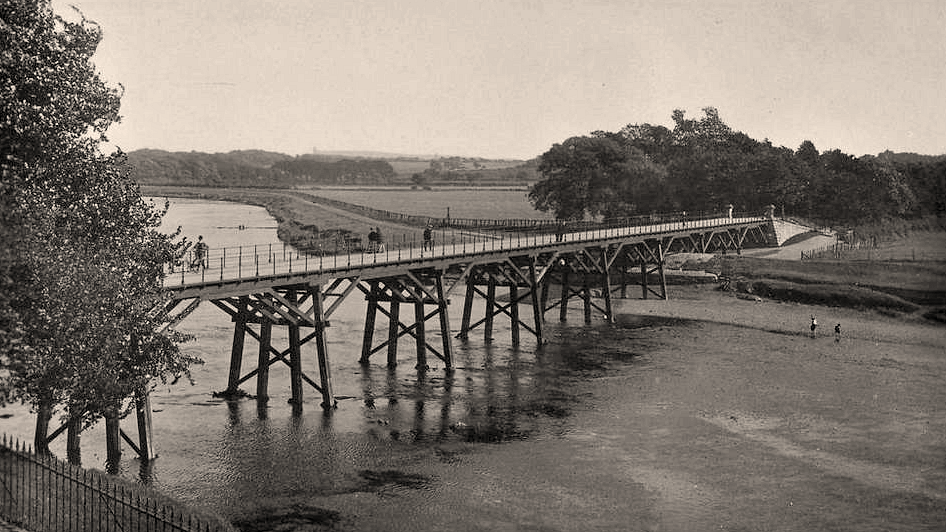
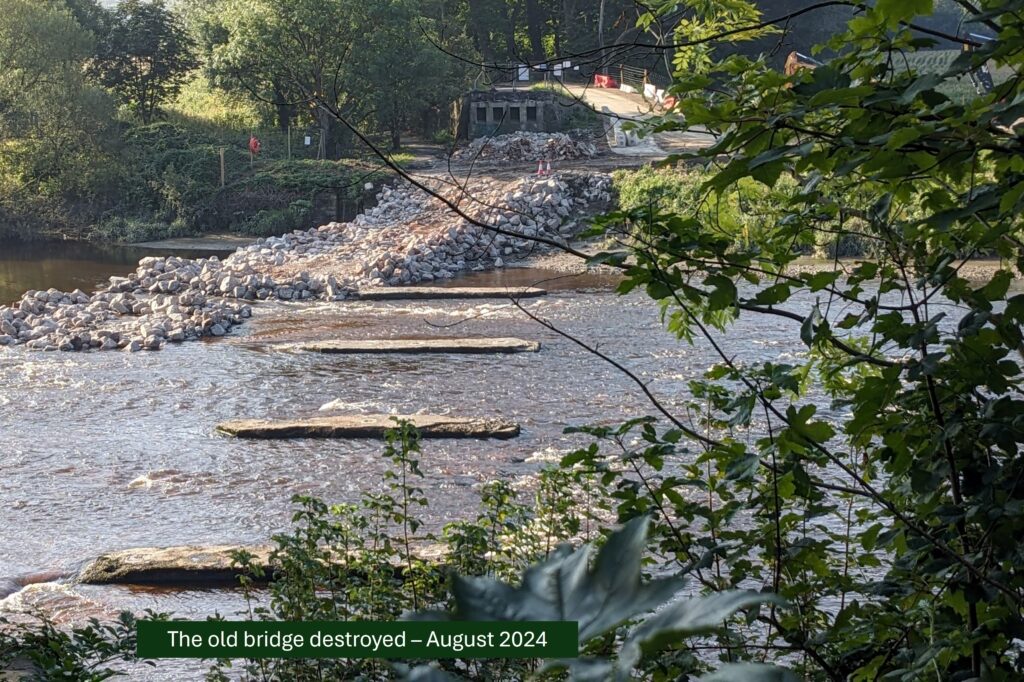
A wooden trestle bridge was erected in 1802 to carry the wagons across the Ribble. Following storm damage in 1935, the wooden supports were replaced by reinforced concrete which remained in place until the bridge was demolished due to safety concerns in 2024. Work on its replacement is underway and is expected to be completed by January 2026.
Approximately 500 navvies were paid 2s 6d per day (considerably more than the average farm worker) to build the tram road which was on an embankment seven feet high (2.1m) across the flood plain to the south of the river before beginning to climb up to where the canal ended at Walton Summit. Parts of the old tram road are still in place, but the construction of the M61 in 1969 and subsequent house building meant that many sections were lost. Today no evidence remains of where the tram road ended at the canal basin at Walton Summit.
Leave a Reply