Monday 20th January – The Lancaster Canal and the Preston Tram Road – Nigel Hardacre
At the first meeting of the new year, the Brindle Historical Society welcomed Nigel Hardacre who is a volunteer at the Lancaster Canal Trust and a member of Friends of the Tram Road Bridge and so was ideally placed to talk about this important trade route which passed close to Brindle.
By 1800, Preston required some 20,000 tons of coal each year and the roads from the nearest mines at Wigan couldn’t cope with this demand and so a canal was planned to bring coal from the south to pass through Preston and on to Lancaster. In addition, limestone from the north could be brought south thus improving the economics of the venture. The northern section of the canal was completed smoothly, but crossing the River Ribble proved very expensive and so a cheaper temporary tram road was built to cover the five miles from Preston to Walton Summit. The engineer John Rennie was commissioned to design an aqueduct over the Ribble, but by the time funding was available for this, the railways had made the scheme uneconomic and so the tram road section remained.
The tram road descended through what is now Avenham Park using concrete sleepers and flanged cast-iron plates. Unlike modern railways, the sleepers were not the full width of the track so as not to impede the horses who walked between the rails. Two horses were used to pull four wagons with a capacity of up to two tons each. The descent to the Ribble was too steep for the horses and so a steam engine was installed to haul the wagons up the 1:6 incline by means of a continuous chain. The tram road had two tracks and so a system was designed to use the weight of the descending wagon full of limestone to help lift the coal coming from Wigan.
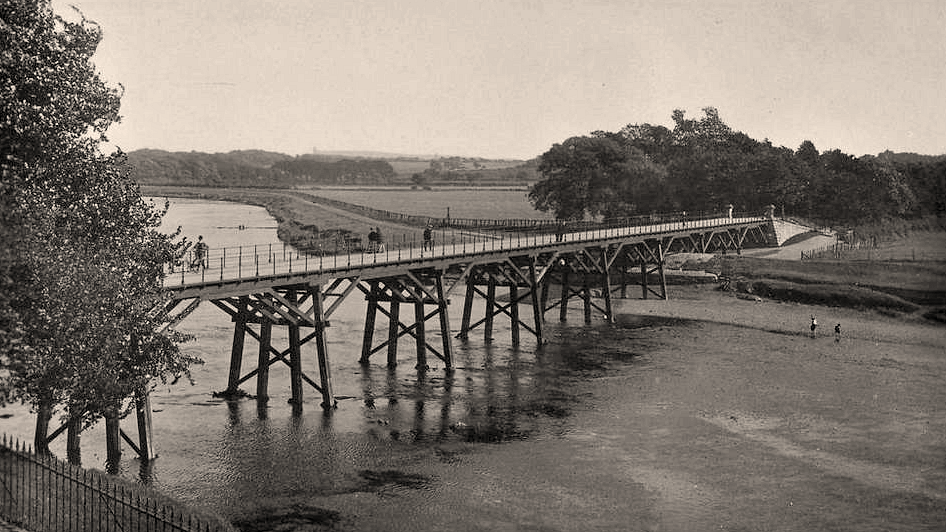
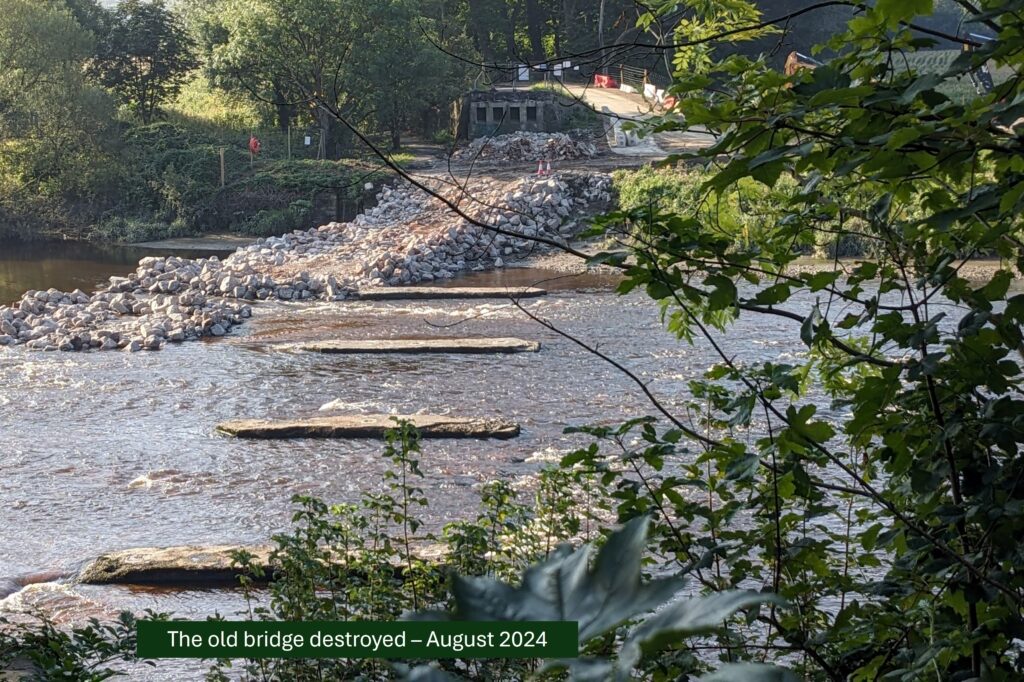
A wooden trestle bridge was erected in 1802 to carry the wagons across the Ribble. Following storm damage in 1935, the wooden supports were replaced by reinforced concrete which remained in place until the bridge was demolished due to safety concerns in 2024. Work on its replacement is underway and is expected to be completed by January 2026.
Approximately 500 navvies were paid 2s 6d per day (considerably more than the average farm worker) to build the tram road which was on an embankment seven feet high (2.1m) across the flood plain to the south of the river before beginning to climb up to where the canal ended at Walton Summit. Parts of the old tram road are still in place, but the construction of the M61 in 1969 and subsequent house building meant that many sections were lost. Today no evidence remains of where the tram road ended at the canal basin at Walton Summit.
Monday 17th March – Rivington Terraced Gardens: Past, Present and Future – Graham Gough
Everyone who lives in Bolton believes that the Rivington Terraced Gardens are located in Bolton but those of us who live in Chorley know that they actually lie within Chorley’s boundary. The talk by Graham Gough in March at the Brindle Historical Society clearly explained to the audience not only where the gardens are but also gave a fascinating insight on how they came to be built, why they fell into disrepair and what is now being done to restore them.
William Hesketh Lever was born in 1851 the son of a Bolton grocer and one of his first jobs as a boy was to help in the shop by cutting up blocks of soap. While still very young, he realised the potential of selling good quality soap which was attractively packaged and marketed. In 1885, he set up the Lever Brothers company and from that enterprise, he became hugely wealthy.
In 1899 much of the moorland East of Chorley was owned by Rivington Hall estates and when this came up for sale, Lever bought it for £60,000. He only wanted the part where he was to establish his gardens and park and so four years later, he sold the remaining land for £140,000! He built a huge house on the hillside which he quaintly named Royton Cottage although his main residence was Thornton Manor in Wirral.
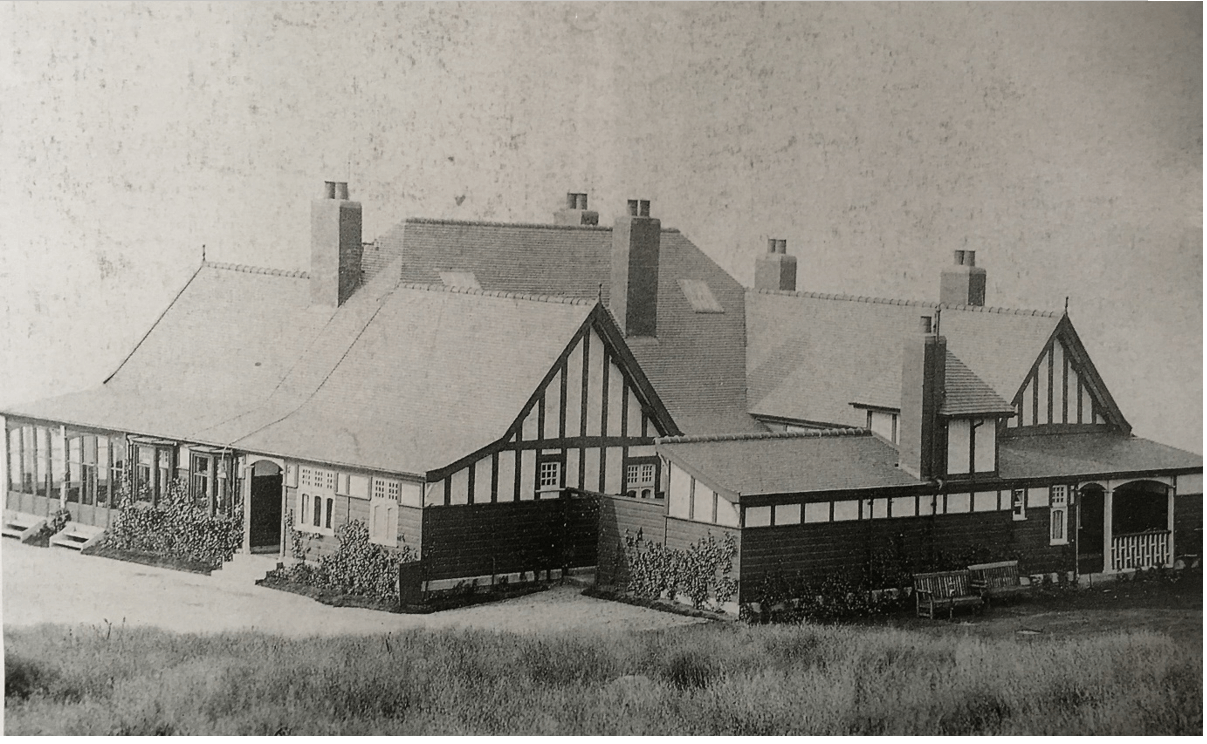
Lever persuaded Thomas Mawson to become his principal landscape architect and instructed him to build a series of gardens and lakes set into what was previously just bare moorland. He also built a large summer house so that he could entertain guests whilst enjoying the views of Morecambe Bay and the Lake District fells to the North and Liverpool Bay and the Welsh mountains to the South. In 1912 he also built a folly beside the reservoir known as Rivington Castle which was a scale replica of Liverpool Castle. This was constructed as a ruin and left unfinished. After the first world war, work continued building the lower gardens and the ravine which was a man-made waterfall fed by an artificial lake around which was built a Japanese garden.
Lever died in 1925 and his family showed no interest in continuing the garden development; they only saw the cost of the venture and sold the gardens to a local brewer John Magee for £15,600. After Magee died in 1931 his family eventually sold the bungalow and grounds to Liverpool Water Corporation in 1940 who paid just £3,000. For the next 60 years the gardens were abandoned and nature took over with many rhododendrons overwhelming the area.
United Utilities (the current owner of the gardens) set up the Rivington Heritage Trust in 1997 who in 2012 managed to secure a grant of £3.4m from the Lottery Fund to restore the grounds. Since then, considerable work has been undertaken by both paid contractors and many volunteers to begin the restoration of these remarkable gardens and buildings.
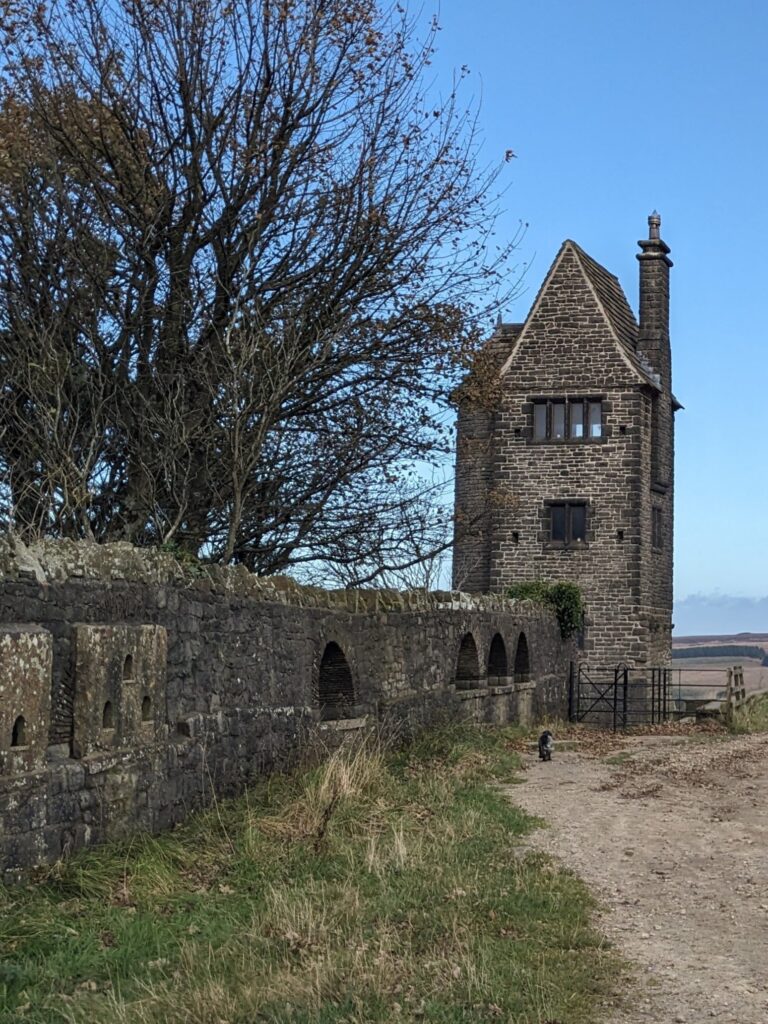
The Pigeon Tower has been fully restored and is now open for visitors on the first Saturday of every month to raise funds for continued restoration. Guided walks and tours can be arranged through the Friends of Rivington Terraced Gardens.
Monday 21st April – Wigan, Radicalism & Gerrard Winstanley – John Winstanley
It’s always great to have one of our own members speaking at the Brindle Historical Society, especially one who can almost claim kinship with the protagonist of the talk. Our speaker this month was John Winstanley who opened his talk by asking who had heard of Gerrard Winstanley of Wigan. Scarcely any hands were raised, but by the end, the audience was delighted to have heard about the exploits of one of the founders of modern-day socialism.
John explained that his interest in Gerrard Winstanley was inspired when he heard Billy Bragg sing a cover of a song called “The world turned upside down” which was written in 1975 following the publication of a book of the same title. This book, by Christopher Hill, brought to much greater prominence the work of Winstanley who died in 1676.
When Borough status was granted to Wigan in 1246, this allowed burgesses to set up merchant guilds which bestowed upon them certain rights to use materials necessary for their trades. However, the Rector / Lords of the manor abused their powers until finally in 1618 the burgesses in Wigan had had enough and collectively went to the King with their grievances. They received an acceptance that they were able to use common land to collect certain raw materials, e.g. clay for the potters. These people became known as the Wigan Diggers.
Gerrard Winstanley was born to a family of cloth merchants in 1609 and moved to London in 1630 to conduct his trade. However, as the English civil war escalated, times became very difficult for Gerrard and in 1643 he was forced to abandon his business. He made his final payment of debts in November and moved out of London, stating, “I was beaten out of both estate and trade and forced to accept of the good will of friends crediting of me’. In near destitution, he found work in Cobham, Surrey as a cattle herdsman and in 1646 he was one of six who were fined for digging peat on the common.
It was during a period of reflection between 1647/8, that he analysed the causes of society’s ills, including his own financial collapse. In his 1648 publication, ‘Truth Lifting up its Head Above Scandals’ he vented his anger at the trading practices that had ruined his business. He asserted that “the earth is a common treasury and is a storehouse for all, giving liberty and freedom to all and that none should own it” and so he set about offering a remedy. He knew of the collective actions of the Wigan burgesses in 1618 and used their success to escalate his theory to a national level. He produced pamphlets which advocated passive occupation of common land as part of the freedom for all, for which the commoners and Parliament went to war with the King.
Today, the Digger Movement of 1649 is what he is most remembered for, since this was when he and others occupied common land on St George’s Hill in Cobham where they dug the soil, planted crops and set up shelters to occupy the commons as a future settlement where they intended to live as free people.
Ultimately, his efforts were unsuccessful since they were driven off the land and forced to flee and abandon the cause. Despite this, his writings secured his future as the foremost radical thinker of the era, although it has taken many centuries for his actions to be fully acknowledged. In commemoration of these events in the 17th century, the Wigan Diggers’ Festival became established as an annual free music event, which this year will be held on 13th September. All are welcome.